
Ask five people in your organisation the same simple question. What is our leave policy for a new parent? Which of our products runs fully offline? What is the sign-off limit before a purchase needs a second approval? You will often get five answers, two of them slightly wrong, and at least one that begins with “I think it changed last year.” The knowledge exists somewhere. Your people just cannot find the current, correct version of it at the moment they need it.
That gap is quiet and expensive. It shows up as the same question asked for the tenth time, as two teams working from two different versions of the same policy, as a new joiner who takes six weeks to learn what they could have learned in six days, and as decisions made on information that was true eighteen months ago. None of it appears on a dashboard. All of it slows the organisation down.
Knowledge everywhere, answers nowhere
Most institutional knowledge is not missing. It is scattered. The HR policy sits in a PDF attached to an old email. The product specification lives in one person's drive. The onboarding checklist is a document nobody has opened since the last reorganisation. And the most important knowledge of all, the real do's and don'ts of how work actually gets done here, is carried in the heads of a few senior people who answer the same questions again and again.
So everyone quietly builds their own private copy of “how things work,” and those copies drift apart. The version in your head is not the version in mine. Multiply that across a few hundred people and you do not have one company, you have a few hundred slightly different ones.
The problem is rarely that the answer does not exist. It is that there is no single place to ask, and no confidence that the answer you get is the current one.
Two kinds of organisational knowledge
Useful as it is to talk about “company knowledge” as one thing, it is really two, and a good system respects the difference.
- Company-wide, for everyone. The knowledge every employee should be able to reach on day one: HR and leave policies, expense and travel rules, the code of conduct, information security do's and don'ts, basic company information, who to contact for what.
- Department-scoped, for a team. The knowledge a single team lives by and others do not need: procurement's approval matrix, legal's contract templates and clause library, the sales playbook, the support runbook, the finance close checklist. Each function has its own internal knowledge, and it should stay with that function.
The goal is not to pour everything into one giant searchable pile. It is to make shared knowledge instantly reachable by everyone, and to keep each team's internal knowledge scoped to that team. One organisation, many rooms, and a clear rule about who is in which room.
What a workspace actually is
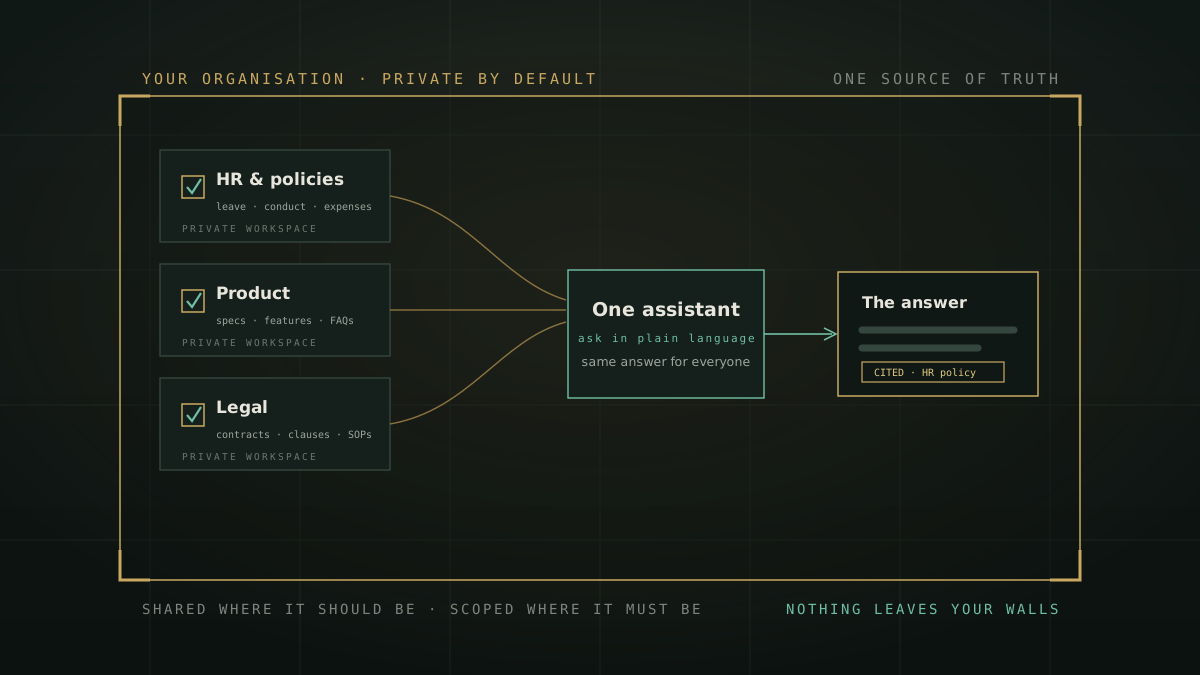
This is the idea behind an Organisation Workspace in ZenithAI. A workspace is a private, governed home for a team's knowledge. You give it the documents that matter, the policies, specifications, standard operating procedures and registers, and you can tell it durable facts it should always remember, such as a threshold, a naming convention or a standing instruction. From then on, anyone with access simply asks a question in plain language and gets an answer drawn from those documents, with a citation back to the exact source.
Company-wide knowledge lives in a workspace an administrator deliberately publishes to the whole organisation. Each department gets its own private workspace, isolated by default. It is one mental model with two scopes: shared where it should be shared, private where it should be private. Website pages, uploaded files and connected databases all feed the same workspace under the same rules, so the knowledge in a room can come from anywhere your team already keeps it.
What that changes for the people who work there
Everyone gets an answer, not a search
The difference between a search box and a workspace is the difference between “here are eleven documents, go and read them” and “here is the answer, and here is the exact page it came from.” Every employee effectively gains a well-read colleague who has memorised every policy, is available at any hour, and never tires of the same question. That is a real change for the people who currently spend their week being that colleague.
One source of truth, not ten copies
When the policy changes, you update it once, in one place, and the answer everyone receives updates with it. Nobody has to hunt for which version is current, because there is only one. Reduced duplication is not a tidiness nicety. Duplicated knowledge is precisely how wrong answers spread: an old copy outlives the correction, and someone acts on it.
The same answer for everyone, always current
Consistency matters most for the things that must not vary from person to person. Compliance rules. Safety procedures. Approval limits. What your staff are and are not allowed to promise a customer. A shared workspace gives the whole organisation the same current answer, cited to its source, every time it is asked. Not a rumour, not a half-remembered version, the actual policy.
Institutional memory that outlasts the people who built it
When an experienced colleague leaves, their knowledge should not walk out with them. Knowledge captured in a workspace compounds instead of resetting. Onboarding shrinks from weeks of asking around to days of asking the workspace, and the questions a new joiner asks quietly improve the knowledge for the next one.
The part most tools quietly skip: privacy
Here is the catch that the polished cloud knowledge tools do not put on the front of the brochure. HR policies, performance notes and internal registers are full of personal data. Under India's Digital Personal Data Protection Act, 2023, your organisation is the Data Fiduciary and your employees are Data Principals, and their salary, attendance, health and performance information is protected by law. The DPDP Rules were notified in late 2025, the compliance runway now points toward 2027, and penalties for getting it wrong run to serious numbers. “Where does our employee data actually get processed” has become a board-level question, not an IT footnote.
Most AI knowledge tools answer that question with one word: their cloud. You upload your knowledge to a vendor's servers, and every question your staff type travels there too. For a public marketing page, that may not matter. For an HR workspace full of employee personal data, it is exactly the third-party processing you are now accountable for.
Making knowledge accessible does not have to mean exposing it. Done properly, the two are separate concerns: knowledge is effortless for your own people to reach, and impossible for anyone outside your walls to touch.
Accessibility and privacy are not a trade-off. They are two different questions, and a private deployment gets to answer yes to both.
How ZenithAI keeps it accessible and private at once
This is the architecture ZenithAI is built on. Organisational knowledge that your people can talk to, running entirely inside your own environment.
- It runs on your infrastructure. The workspaces, the documents and the models that answer all sit inside your environment, on-premises or in your private cloud. Nothing about your knowledge has to leave it. More on that in security and governance.
- Private by default, shared on purpose. A workspace is scoped to its owner and team. Another user's workspace does not merely refuse access, it does not acknowledge that it exists. Company-wide knowledge is shared only through a deliberate administrative decision, never by accident.
- Access-controlled and audited. Who can reach which knowledge is governed, and privileged access is logged, so you can show who could see what.
- It supports your DPDP obligations. Because employee personal data stays inside your boundary and under your own controls, you are supporting the obligations the Act places on you rather than handing that data to an outside service to process on your behalf.
A careful word on that last point, because privacy language invites overstatement. This is architecture, not a certificate. No product makes an organisation “DPDP compliant” on its own; your data-handling policies, your consent practices and your legal review still do that work. What a private deployment does is keep the choice, and the data, on your side of the wall, which is a far easier position to defend. This article is a practical discussion, not legal advice.
Where to start
You do not need to move your whole organisation at once. Pick the one workspace worth building first, and the answer is almost always the same: the company-wide HR and policy workspace. It is the highest-frequency knowledge in the building, everyone needs it, the questions repeat endlessly, and the answers are exactly the ones that must stay consistent. Build that, let people feel what it is like to just ask, and then give two or three departments their own private workspaces.
The knowledge you already own, sitting in drives and inboxes and the heads of your most experienced people, becomes an asset your whole organisation can use, in the same voice, with the same answer, and without a single document leaving your control. If you want to see it on your own policies, request a demonstration and bring a handful of documents your teams argue about most. See also how ZenithAI turns your public website into private, cited knowledge and what the wider platform does for everyday work.