
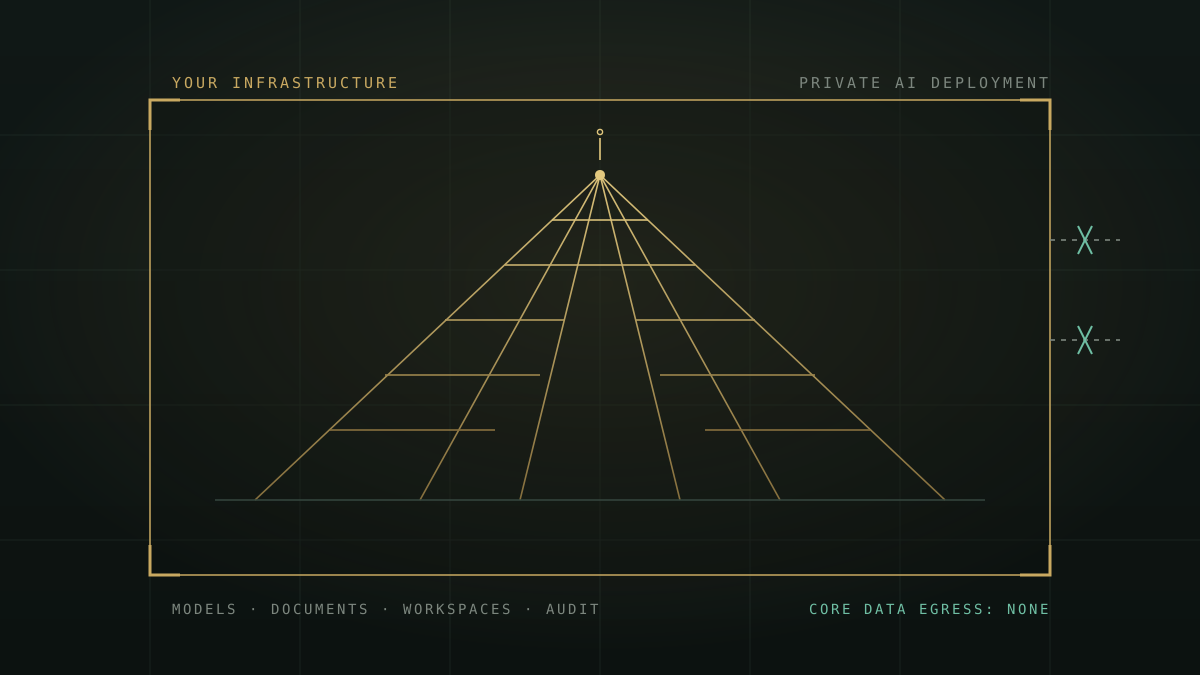
Over the last three years, most enterprises answered the generative-AI question the fast way: subscribe to a public cloud AI service, send your prompts and documents to someone else’s infrastructure, and rent the answers back by the token. For a growing number of institutions — banks, hospitals, government departments, manufacturers — that trade is starting to look like the wrong one. This guide covers the alternative: private AI deployment, what it actually involves, and how to evaluate it.
What “private AI deployment” actually means
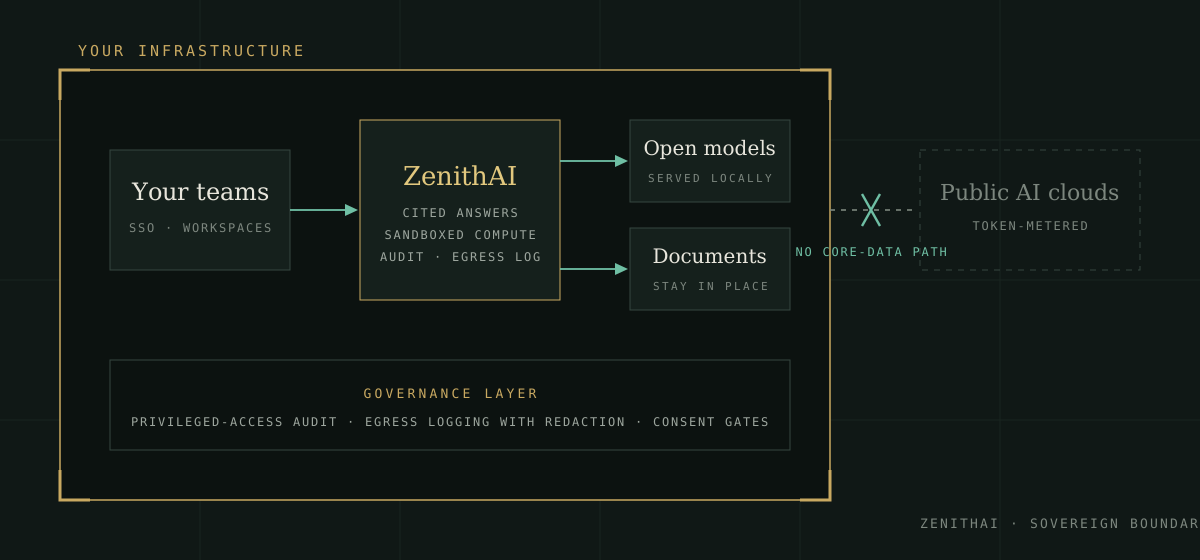
Private AI deployment means the entire AI stack — the language models, the document retrieval index, the chat workspaces, the audit trail — runs on infrastructure your organisation controls: your own data centre, or a private cloud tenancy you administer. Employees get the same kind of assistant experience they’d get from a public service. The difference is where the thinking happens.
With a public AI service, every question an employee asks — and every document they attach — travels to an external provider, is processed under that provider’s terms, and is governed by that provider’s policies. With a private deployment, the models are served locally, next to the data they reason over. Your questions, your documents and the answers they produce stay within your boundary.
Why institutions are making this move now
Three pressures are converging.
- Data sovereignty. Institutional knowledge — legal opinions, patient records, loan files, board papers — is the asset. Sending it to external AI services, even under enterprise agreements, creates a dependency and a disclosure surface that many boards are no longer comfortable signing off. India’s DPDP Act, 2023 sharpens this: a private deployment, where personal data never needs to leave your infrastructure to be reasoned over, gives your compliance team an architecture that supports those obligations rather than one they must argue around.
- Cost predictability. Token-metered AI is a variable cost that grows with success: the more your teams use it, the more you pay. Budget holders can’t forecast it, and heavy users learn to ration a tool that should be everywhere. A licensed private platform inverts this — on your own deployment there is no per-token billing and no per-user meter, so the marginal cost of the ten-thousandth query is the same as the first: nothing beyond the infrastructure you already run.
- Governance. Regulators and internal audit increasingly ask not “do you use AI?” but “can you show us what it did?” That demands citations on answers, logs on privileged access, and consent gates on actions — controls that are far easier to enforce when the whole stack is yours to instrument.
The question is no longer whether your enterprise will use AI. It is whether your enterprise will own it — or rent it forever.
What to look for in a private AI platform
Running an open-weight model on a server is a weekend project. Running an institution on one is not. When you evaluate platforms, look past the demo and ask about the machinery around the model:
- Cited answers, not confident guesses. When the assistant answers from your documents, it should show which pages the answer came from, so a human can verify before acting. This is core to how ZenithAI’s workspace handles document intelligence.
- Real computation on spreadsheets. Financial figures should be computed in a sandbox, not estimated by a language model. If a platform can’t tell you how it gets numbers right, assume it doesn’t.
- Governance you can show an auditor. Privileged-access audit that fails closed, egress logging with redaction, and hard consent gates before the system sends an email or places a call on anyone’s behalf. Our security & governance page describes the full manifest we ship with.
- Open foundations. Open-weight models and open serving technology mean your platform never depends on a single proprietary vendor’s permission — and can be upgraded as open models improve. See how ZenithAI tiers its models from instant drafting to deep reasoning.
- A deployment model, not just software. Sizing, installation, tuning to your hardware, and a long-term maintenance relationship. Enterprise AI is a decade-long commitment; the deployment engagement should be structured that way.
The economics, honestly stated
Private deployment is not free — it front-loads cost into hardware, a one-time platform licence, deployment and an annual maintenance contract. What it removes is the meter. On your own deployment, token billing is ₹0 and there is no per-user charge, so the economics improve with every additional employee who adopts the platform — the opposite of subscription AI, where adoption is the thing you end up throttling. For organisations past a few hundred knowledge workers, that crossover arrives quickly; the economics section of our homepage walks through the comparison.
Getting started
A private AI programme doesn’t begin with a hardware order. It begins with three questions: which teams have the most to gain, which documents hold the knowledge they work from, and which controls your auditors will ask to see. From there, a scoped pilot on a single department’s corpus proves the pattern before you scale it.
For the compliance side of this decision, see our companion piece on the DPDP Act questions to ask before adopting enterprise AI.
If you’re weighing this move, request a demonstration — enterprise enquiries reach the team that builds the platform, engineers included. And if you want the background on who we are, our company story covers 26+ years of building institutional platforms in India.