
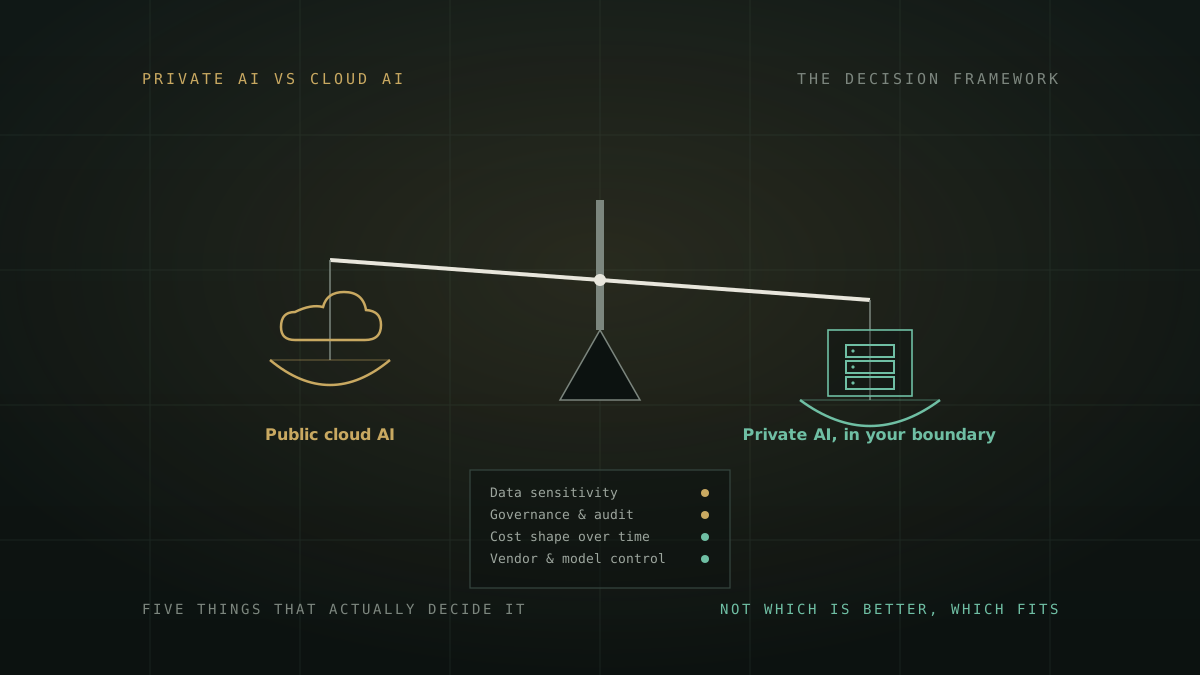
Every enterprise adopting AI eventually asks the same question, in the same wrong shape. “Which is better, cloud AI or private AI?” That question has no answer, because the two are not competing on the same axis. The real question is narrower and more useful: for this workload, with this data, on this timeline, which one actually fits? This is the framework for answering that, honestly, including the cases where a cloud subscription is still the right call.
A note before we begin. This is an architectural and commercial framework, not legal advice, and it deliberately stays at the category level: “cloud AI” here means any hosted, per-seat or per-token AI subscription, and “private AI” means a deployment that runs on infrastructure the organisation owns or controls. It is not a scored comparison against any single named product.
Why “which is better” is the wrong question
Cloud AI and private AI are not two versions of the same thing with one being the upgrade. They are two different arrangements of the same four questions: where does the data go, who chooses the model, who carries the cost as usage grows, and who can produce the audit trail. A cloud subscription answers all four in the vendor's favour by default, in exchange for speed and simplicity. A private deployment answers all four in the organisation's favour by default, in exchange for standing up and running infrastructure. Neither arrangement is wrong. The mistake is assuming one arrangement is correct for every workload in the organisation, when in practice most enterprises end up running both at once, cloud AI for low-stakes general use, private AI for the material that actually matters.
The five things that actually decide it
Strip the marketing language from both sides and the decision comes down to five factors. Here is how each behaves under cloud AI and under private AI.
| Dimension | Public cloud AI | Private AI, on your infrastructure |
|---|---|---|
| Data residency | Prompts and documents are processed on the vendor's cloud, under the vendor's data-handling terms. | Data stays inside infrastructure the organisation designates. Residency is a decision the organisation makes, not one it asks a provider for. |
| Governance & audit | Audit evidence, access logs and controls exist on the vendor's terms and are requested, not owned. | Access controls, audit ledgers and egress logging run on the organisation's side and can be produced without a supplier's involvement. |
| Cost shape over time | Per-seat or per-token billing that recurs in full every year and grows with every person added. | Mostly a one-time cost plus a small annual maintenance charge, so the cost per user falls as the organisation grows. See the full TCO breakdown. |
| Model & vendor control | A single vendor's model, priced and updated on the vendor's schedule; switching means re-integrating everything. | Open-weight models the organisation runs, exchangeable per deployment, with no proprietary vendor required for core reasoning. |
| Time to first value | Often live the same day. No infrastructure to size or stand up. | Measured in weeks: sizing, implementation, rollout. Slower to start, flatter to run. |
Notice the pattern. Cloud AI trades control for speed. Private AI trades speed for control. Every real decision is about which of those two things your organisation needs more, for this workload, right now.
A five-question test for your next AI decision
Before signing for any AI system, built, bought or subscribed, run the workload through five questions:
- Data: If this data left our infrastructure, would that be a real problem, not just an uncomfortable one?
- Scale: Will more than a few dozen people use this, for years rather than months?
- Governance: Do we need to produce an audit trail or prove where this ran, to a regulator, a board or a customer?
- Lock-in: If the vendor changed price, terms or availability tomorrow, would this workload survive it?
- Timeline: Do we have weeks to stand this up properly, or do we need an answer this afternoon?
If three or more of the first four answers are yes, and the fifth is not urgent, private AI is very likely the right architecture. If most of the first four are no, or the fifth is urgent, a cloud subscription is the pragmatic move, and there is no shame in that. It is simply the right tool for a workload that has not yet earned the heavier commitment.
When cloud AI is still the right call
Honesty cuts both ways, so here is the case against a private deployment. A small team, a workload with nothing sensitive in it, or an organisation still deciding whether AI earns its keep at all, all point toward a cloud subscription. There is no infrastructure to run, no one-time cost to recover, and you find out quickly whether the workload delivers. Standing up private infrastructure for a five-person pilot with no sensitive data is not caution, it is friction with no payoff. The private-deployment case is strongest exactly where the cloud case is weakest: real scale, real sensitivity, a real horizon. Most organisations discover both cases exist inside the same building, for different workloads, at the same time.
The same question, well beyond India
This decision is not a local one. Data protection frameworks in Europe, moves toward data localisation in parts of the Gulf and Southeast Asia, and India's own DPDP Act, 2023 are different laws with different mechanics, but they all point the same direction: more organisations, in more places, are being asked where their sensitive data actually goes, not just whether it is protected in transit. That does not mean every workload everywhere needs a private deployment. It means the five-question test above is becoming a live question for enterprises in most jurisdictions, not a niche one, and it is worth running deliberately rather than defaulting to whatever a team signed up for first. For institutions where this question rises to the level of national or sectoral policy, see how it plays out for sovereign AI at the institutional level.
The lowest-friction way to compare
Reading a framework is one thing. Feeling the difference is another. If you want to see what “private, on your infrastructure” actually behaves like before any conversation with a sales team, the API playground lets you call five of ZenithAI's capabilities live, with your own key, no form in the way. If the workload in front of you already looks like it belongs on the private side of this framework, bring your headcount and your current spend to the TCO calculator and see the shape of your own numbers.
Where to take it
The decision this article walks through is architectural, and it is worth making deliberately rather than inheriting whatever a team signed up for during a trial. If the five-question test points toward private AI for a real workload, request a demonstration and bring the workload, not just the question. If you are still weighing it, talk to our team, no obligation either way. See also the full cost breakdown for the economics, and security & governance for the architecture behind the control side of this table.