
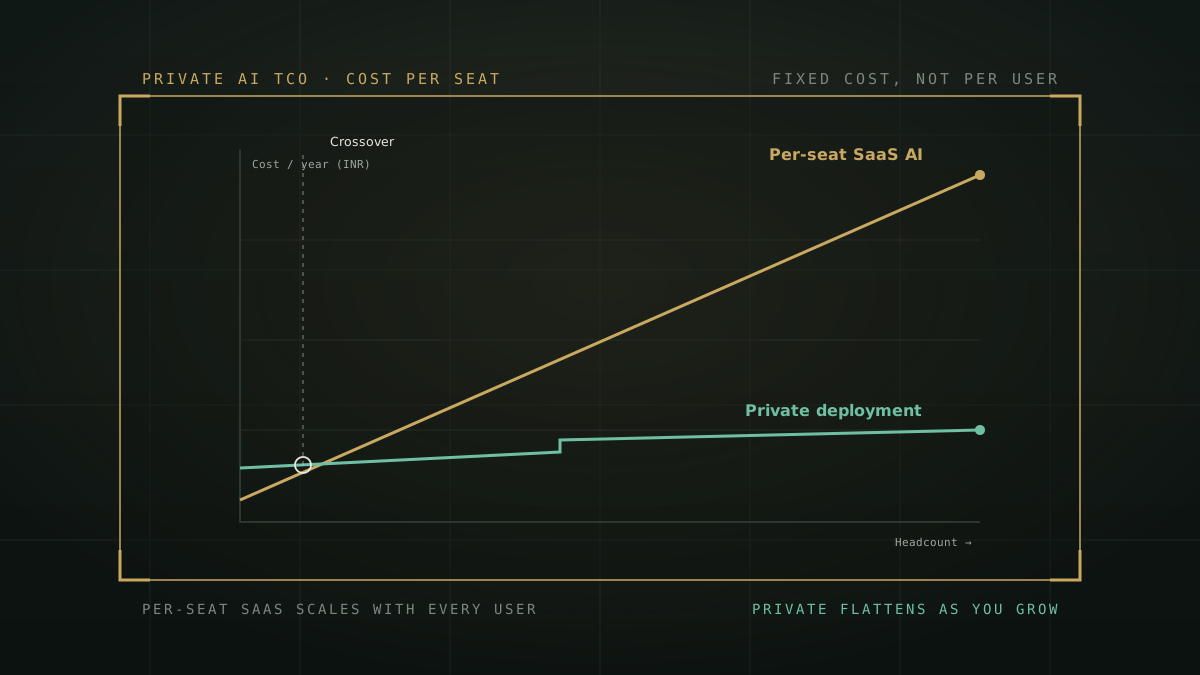
The question every Indian CFO eventually asks about enterprise AI is not “which model is best.” It is “what does this actually cost us over three years, in rupees, once everyone is using it.” That is a total-cost-of-ownership question, and per-seat SaaS AI and a private, self-hosted deployment answer it in opposite shapes. One grows with every person you add, and lands again every year. The other is mostly a one-time cost that does not. This is the honest comparison, with the numbers, the forex exposure, and the point where a private deployment pays for itself.
A note before we begin. This is a commercial and architectural discussion, not tax, legal or investment advice. The vendor prices below are public list prices or public procurement reporting, dated to August 2026, and they change. The private-deployment figures are indicative ranges, clearly labelled illustrative, meant to show the shape of the maths rather than a quote. Work your own numbers with your finance and IT teams.
Two cost shapes, not two price tags
The mistake is comparing a per-user price to a per-user price. That is not the real difference. The real difference is the shape of the cost as your organisation grows.
Per-seat SaaS AI is a rising line that resets every year. Every user is a fixed monthly charge, so ten users cost ten times one user, a thousand users cost a thousand times one, and the whole bill lands again next year. The cost per user never falls. It cannot, by design. A private deployment has a different shape entirely. There is one upfront step, the cost of standing it up, and then a nearly flat line, because the only recurring cost after that is maintenance. That step does not grow taller as you add people. So the cost per user falls as you grow, and the money you were handing over for seats starts paying the one-time cost back. Put the two shapes on the same chart and they cross. Everything in this article is about finding that crossing, and how quickly it pays for itself.
The per-seat SaaS reality in India
Here are the publicly listed prices as they stand in August 2026, converted to rupees at roughly ₹95.2 to the US dollar (the rate on 6 August 2026). All figures are shown before GST, which we handle separately below.
| Per-seat AI tool | Listed price | Billing & terms | Approx. ₹/user/mo |
|---|---|---|---|
| Google Workspace Business Standard (Gemini included) | ₹1,080/user/mo (list) | INR-billed, monthly | ₹1,080 |
| ChatGPT Business | $20/user/mo (annual), $25 monthly | USD-billed, 2-seat minimum | ~₹1,905 |
| Microsoft 365 Copilot (add-on) | ₹2,495/user/mo (paid yearly) | INR-listed, GST extra, requires a qualifying M365 licence | ₹2,495 + base |
| ChatGPT Enterprise | No published list price | Quote-only; reporting clusters at $45 to $75/seat, 150-seat minimum, annual prepay | ~₹4,300 to ₹7,150 |
Two honest caveats belong right here. The Microsoft 365 Copilot price of ₹2,495 is an add-on: it sits on top of a qualifying Microsoft 365 Business or Enterprise licence you already pay for, so the true seat cost is higher than the headline. And ChatGPT Enterprise has no public list price at all; the ₹4,300 to ₹7,150 band is procurement reporting, not an official rate, and we keep it out of the comparison table below for exactly that reason. What every row shares is the important part: the number repeats, in full, for every single user, every single month, forever.
A per-seat price is not a cost. It is a cost multiplied by your headcount, and then again by the exchange rate, at every renewal.
The costs that do not show on the price page
Per-seat billing hides a second layer that Indian finance teams learn about later:
- Usage overages. Several tools meter heavy usage, agent runs or premium requests on top of the seat, so the “fixed” per-user price is a floor, not a ceiling.
- Seat sprawl. Licences get provisioned and forgotten. You pay for seats that logged in twice and never came back, and reclaiming them is somebody's unglamorous quarterly job.
- Forex on renewal. A dollar-billed contract is re-priced in rupees every year by the exchange rate. The rupee weakened roughly 9 percent against the dollar over the twelve months to August 2026. That is close to a 9 percent rupee increase on a flat contract, for no extra value, before the vendor raises the list price. Rates move both ways, but the exposure is real and it is one-directional in your risk model.
- Data leaving the organisation. Every prompt is processed on the vendor's cloud. For public marketing copy that is fine. For HR records, board papers, customer data and pricing, it is third-party processing you now have to account for under the DPDP Act. That is a risk cost, and we return to it below.
The private deployment: a one-time cost, then a small annual charge
A private, self-hosted deployment runs the platform and the models inside your own environment, on-premises or in your private cloud. It is emphatically not free, and pretending otherwise would wreck the credibility of everything else here. What it is, is mostly one-time. The large costs, the hardware, the platform licence and the implementation, are paid once. You size the infrastructure for your organisation, and the same infrastructure serves your whole workforce, with no per-token bill and no per-user meter. Here is an honest, illustrative build-up of the one-time cost for a mid-sized deployment, before GST.
| One-time component | What it covers | Indicative ₹ (one-time) |
|---|---|---|
| Inference hardware | GPU server sized for your workforce | ₹18 to 25 lakh |
| Platform licence | The platform, on infrastructure you own | ₹18 to 25 lakh |
| Implementation and rollout | Integration, knowledge onboarding, go-live | ₹5 to 10 lakh |
| Indicative one-time total | Mid-sized deployment, illustrative | ~₹50 lakh once |
After that first year the recurring cost is small. Annual maintenance and support, power and cooling, and a fraction of an IT person's time typically land near 15 percent of the one-time figure, so about ₹7 to 8 lakh a year for the deployment above. That is the only number that repeats, and it does not grow when you hire. Set it beside per-seat billing, where the full amount repeats for every user, every single year, and the difference in shape is the whole story.
A word on the hardware, because the internet will scare you. You will read that an AI server costs ₹2 to 5 crore. That is a training-class cluster with multiple top-end accelerators, and running an enterprise assistant does not need it. Inference for a private workforce assistant is a far more modest machine, which is why the hardware line above is tens of lakhs, not crores. The point is the shape, not the decimal: a one-time investment, a small annual charge, and neither one cares how many people you hire.
The five-year picture: payback, not just price
This is the centrepiece. We hold the per-seat tool at a representative ₹2,000 per user per month (₹24,000 a year), roughly the midpoint between an entry business plan near ₹1,905 and the Microsoft 365 Copilot add-on at ₹2,495. We compare five years of that against a private deployment priced the honest way, a one-time cost plus 15 percent a year in maintenance, sized up modestly as the organisation grows. Headcount is held flat within each row so the comparison is clean, and everything is before GST.
| Headcount | Per-seat, 5 years | Private, 5 years | Net saving, 5 years | Payback |
|---|---|---|---|---|
| 50 | ₹60 lakh | ₹52.5 lakh | ₹7.5 lakh | ~4 years |
| 250 | ₹3 crore | ₹87.5 lakh | ₹2.1 crore | under 1 year |
| 1,000 | ₹12 crore | ₹1.58 crore | ₹10.4 crore | a few months |
| 5,000 | ₹60 crore | ₹3.5 crore | ₹56.5 crore | a few months |
Read the last two columns. At fifty people a private deployment costs about ₹52.5 lakh over five years against ₹60 lakh of per-seat billing, so it saves a little and recovers its one-time cost in about four years. That is the honest floor: below roughly forty to forty-five people, or over a short and uncertain horizon, an entry per-seat plan is the pragmatic choice, and you should say so out loud. But the moment you are a few hundred people, the picture is not close. At two hundred and fifty people the private deployment pays back inside the first year and saves around ₹2 crore over five. At a thousand people it saves more than ₹10 crore. That is not a rounding difference. It is a different line in the annual budget, and it is recovered in months, not years.
Your payback depends on the seat price you pay
The crossover is not a law of nature. It is an artefact of two inputs: the per-seat price and the private deployment cost. Change the seat price and it moves. Over five years, against an indicative small deployment (a one-time ₹30 lakh plus about 15 percent a year in maintenance), a private deployment pays back above roughly:
| If your per-seat AI costs... | Example | Private pays back over 5 years above... |
|---|---|---|
| ₹1,080/user/mo | Workspace Standard, Gemini included | ~80 seats |
| ₹1,905/user/mo | ChatGPT Business, annual | ~46 seats |
| ₹2,495/user/mo | M365 Copilot add-on (plus base) | ~35 seats |
| ~₹5,700/user/mo | Enterprise-tier reporting | ~15 seats |
The pattern is the point: the more governed and enterprise-grade the per-seat tool, the sooner private pays back, because you are paying the premium tier on every head, every year. A three-hundred-person company on a governed enterprise seat crossed that line a long time ago.
Work out your own payback in two minutes. We built a free Private AI vs Per-Seat ROI calculator. Put in your headcount, your per-seat price, your one-time cost and your growth plan, and it shows your payback period and your multi-year return in rupees. No form in the way.
GST, forex and the Indian procurement lens
A fair comparison keeps the tax treatment symmetric. GST at 18 percent applies to both columns: to per-seat SaaS, and to private hardware, licence, AMC and colocation. Every figure in this article is shown before GST for that reason. Input tax credit treatment differs by how each is structured and by your own registration, so take that to your finance team rather than assuming it favours one side. The genuinely one-sided factor is not GST. It is forex.
Most enterprise AI seats are billed in dollars. A private deployment is bought and maintained largely in rupees. That is why the two behave so differently on a treasury dashboard. A dollar-billed per-seat contract is opex that recurs, grows with headcount, and is re-priced by the exchange rate at every renewal. A private deployment can be treated as capex you own and amortise, or as a rupee licence plus maintenance, and the number is set in advance. For an Indian CFO who has to defend a three-year budget, predictability in rupees is not a soft benefit. It is the whole reason the finance function exists.
The per-seat model asks you to re-underwrite your AI budget every year, in a foreign currency, against a headcount you hope will grow. The private model asks you to set it once.
Beyond the rupees: the risk that shares the same answer
The striking thing about this comparison is that the cheaper option at scale is also the lower-risk option, so you are not trading money against safety. The same private deployment that flattens the cost curve also:
- Keeps data resident. Prompts and organisational data stay inside your infrastructure rather than travelling to a vendor's cloud. That supports the obligations the DPDP Act, 2023 places on you, and it keeps residency a decision you make, not one a provider makes for you. To be precise, this is architecture, not a certificate: no product makes an organisation “DPDP compliant” on its own, and this is not legal advice.
- Protects the confidentiality of prompts. The questions your people ask an AI (about a deal, a defect, a person, a plan) are themselves sensitive. On your own deployment they are not another company's training or telemetry surface.
- Removes vendor lock-in. There is no seat you must keep renewing to retain access to your own knowledge, and no annual re-pricing you cannot escape.
- Makes the budget predictable. Capex or a rupee licence, amortised on your terms, is a number your board can plan around. For regulated sectors, see how the same posture reads against sovereign AI at the institutional level.
This is the ZenithAI position in one line. The platform runs inside your environment, so the cost is fixed rather than metered, and the data stays on your side of the wall. More on the platform, the deployment model, and the commercial structure of a one-time licence with maintenance rather than a per-user meter.
When per-seat is the right answer
Honesty cuts both ways, so here is the case against ourselves. If you have a small team, a short horizon, or you are still deciding whether AI earns its keep at all, a per-seat plan is the right first move. Low commitment, nothing to run, and you find out fast whether it delivers. The private deployment earns its place when three things are true at once: enough users that per-seat billing has become a serious line item, data sensitive enough that where it is processed matters, and a horizon long enough to recover the one-time cost. For a growing Indian enterprise, all three tend to arrive together, and usually sooner than the finance team expected.
Where to take it
The move most enterprises make is not all-or-nothing. It is to run the maths on their actual headcount and growth, find where their own line crosses, and plan the switch for the point where per-seat billing stops being convenient and starts being expensive. If you want that worked through on your real numbers, request a demonstration and bring your headcount, your current per-seat spend and your three-year hiring plan, or simply get in touch and we will build the model with you. See also our enterprise deployment guide for what standing up a private deployment actually involves, and the broader private AI vs cloud AI decision framework if cost is only one of the factors you are weighing.