
“Sovereign AI” is suddenly everywhere in India. The IndiaAI Mission — sanctioned at roughly ₹10,372 crore — is standing up national compute, supporting a slate of home-grown sovereign models, and building datasets and safety institutions so the country’s AI can run on Indian terms. It is a genuinely important national project. But it answers a national question. For a single bank, PSU, hospital or manufacturer, a narrower and more urgent question remains: when your institution puts AI to work, whose hands are on your data, your models and your controls?
A note on scope: this is a strategy and architecture discussion, not legal advice, and ZenithAI is not part of the IndiaAI Mission — we reference the national programme only as context. Public figures cited here are drawn from press reporting on the Mission and may change as it evolves.
Two very different meanings of “sovereign”
The word is doing double duty, and the confusion is costing decision-makers clarity. At the national level, sovereign AI means a country having its own compute, its own foundation models and its own data — capability that doesn’t depend on a foreign vendor’s permission. Reporting around the IndiaAI Mission describes tens of thousands of GPUs already deployed for shared national use, on a path toward a six-figure public GPU pool, plus a programme of Indian sovereign models. That is nation-building.
At the institutional level, sovereign AI means something you can actually own this quarter: the assurance that your organisation’s knowledge, the models reasoning over it, and the record of what those models did all sit inside your boundary — not on a metered API you rent. A national GPU cloud does not, by itself, make your board papers or your customers’ KYC files sovereign. That is an architecture decision only you can make.
National sovereign AI is about the country’s capability. Institutional sovereign AI is about who holds the keys to your data. You need the second regardless of the first.
Why the pressure is arriving now
Three forces are converging, and they all point the same way — toward keeping the regulated core in-country and in-house:
- Data-protection law. The DPDP Act, 2023 puts real obligations on how personal data is processed, minimised and accounted for — obligations that get much harder to satisfy when every prompt is shipped to an outside service.
- Sectoral rules. The RBI’s 2026 draft model-risk guidance tells banks and NBFCs they must be able to explain, oversee, audit and switch off their AI — controls that are far easier to hold when the system runs on your side of the wall.
- Data localisation. The national direction of travel is that sensitive data in finance, defence and healthcare should stay within India’s borders. “Sovereign,” for a regulated enterprise, increasingly means resident.
None of these say “never use AI.” They say: for the material that matters, you have to be able to prove where it went and who could touch it. That is an ownership problem before it is a technology problem.
The four pillars of institutional sovereign AI
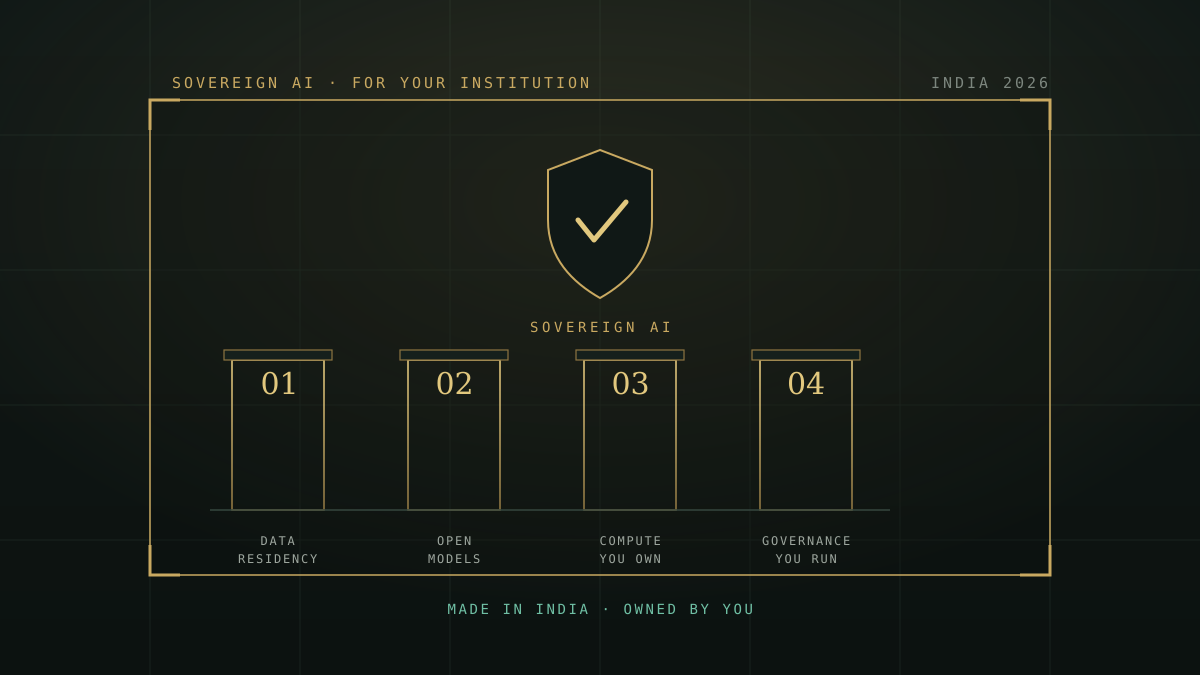
Strip away the slogans and sovereign AI, at the level of one organisation, rests on four things you either control or you don’t:
- Data residency. Your documents, records and every prompt and answer stay inside infrastructure you designate — not copied to a third party’s systems to be processed, logged, or used to improve someone else’s model.
- Models you control. The intelligence runs on open-weight models on your hardware, so your capability doesn’t depend on an external vendor’s pricing, availability or terms of the month.
- Compute you own. The system runs on infrastructure you own or hold under your own tenancy — on-premise or private cloud — so there is a physical answer to “where does this run?”
- Governance you run. The audit trail, the access controls, the switch-off — all operated by you, producing evidence you can hand a regulator without asking a supplier’s permission.
Notice that only the second pillar is really about “AI.” The other three are about ownership, residency and control — which is exactly why a faster or cleverer rented model doesn’t answer the sovereignty question. It answers a different one.
How a private deployment delivers the four
This is the architecture ZenithAI is built around — institutional sovereignty by default rather than as an add-on:
- Residency — ZenithAI is deployed inside your own infrastructure. Organisational data and the models reasoning over it stay in your environment; the core platform is engineered so nothing about your content has to leave it. See security & governance.
- Models — the core runs open-weight models on your hardware, with no proprietary model vendor in the loop for the core reasoning. Your intelligence isn’t leased. More in our enterprise deployment guide.
- Compute — on-premise or private cloud, with a one-time licence, AMC and support rather than a per-token meter — the commercial shape that matches owning, not renting.
- Governance — a fail-closed privileged-access audit ledger, egress logging with redaction, consent gates before consequential actions, and a deployment that is yours to suspend or restrict. The evidence sits with you.
A precise word on claims, because sovereignty invites overstatement. ZenithAI is designed to keep data and models inside your boundary and to put the controls on your side of it; it is not a certificate of compliance, and no product makes an institution “sovereign” or “DPDP compliant” on its own. Your data-residency choices, your governance framework and your legal review still do that work. What the architecture does is make those choices yours to make — and cheaper to defend — instead of a provider’s to grant. It is, in the plainest sense, built in India, to run under your control.
A sovereignty checklist for your next AI decision
Before you sign for any AI system — built, bought or subscribed — run it through four questions:
- Residency: Where do our documents and prompts physically go, and can we prove they stay in-country and in-boundary?
- Models: If our vendor changed price, terms or availability tomorrow, would our AI capability survive it?
- Compute: Is there a physical location we own or control where this runs — or only someone else’s API?
- Governance: Can we produce the audit trail and pull the switch ourselves, on demand, without a third party?
Where an answer depends on a supplier’s assurance, log it as residual risk. Where it depends on your own infrastructure, log it as sovereignty you actually hold. The gap between those two columns is the real measure of how sovereign your AI is.
Frequently asked questions
What is sovereign AI?
Is sovereign AI the same as private AI?
Does India have a national sovereign AI programme?
What does an enterprise actually need to make its AI sovereign?
Does a private AI deployment make an enterprise DPDP compliant?
Where to take it
The national sovereign-AI push and your own are not in competition — they reinforce each other. But your board can’t wait for a national programme to make your institution’s AI sovereign; that is an architecture you choose. If you’re weighing how to bring AI into a bank, PSU or regulated enterprise on your own terms, request a demonstration and bring your risk and IT teams. For a concrete first step, see how ZenithAI turns a public website into private, cited knowledge — or how it serves regulated and public-sector organisations. If sovereignty is one of several factors you are weighing rather than a settled requirement, see the broader private AI vs cloud AI decision framework, including where a cloud subscription is still the right call.