
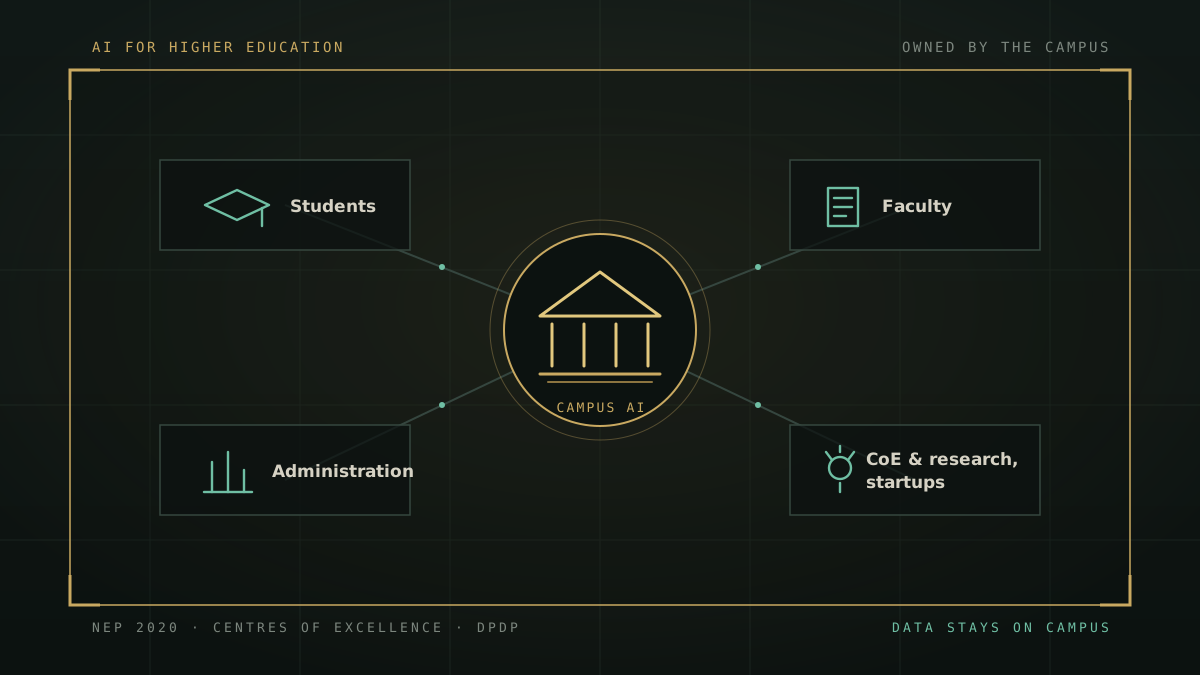
India has decided that AI belongs in education. The National Education Policy asks for it in the curriculum, the Union Budget has funded a Centre of Excellence in AI for education, and a national mission is renting out one of the world's largest public GPU pools at subsidised rates. What none of these programmes decide is the question that lands on a Vice-Chancellor's desk: when your students, your teachers and your registrar's office use AI every day, whose machine is it running on, and who can see what they typed? This is a practical guide to the campus-owned answer, written for the people who run universities: what a private AI platform actually gives students, faculty, administration, your Centre of Excellence and the startups in your incubator.
The public programme figures above are drawn from press reporting and government announcements and may change; ZenithAI is not part of these programmes. This article is a practitioner's view, not legal advice.
The moment universities are in
Walk any campus this year and AI is already there. Students draft with it, teachers plan with it, and free consumer AI subscriptions have been distributed to students at national scale. The adoption question is settled. What is not settled is governance. A student pasting a draft dissertation into a free tool is sending it to somebody else's server, under somebody else's terms. A registrar's clerk summarising a grievance file the same way may be moving personal data of a minor across a border without anyone having decided to. The institution carries the responsibility either way.
The uncomfortable truth is that a university cannot govern what it does not run. Policy circulars can ask for disclosure, but they cannot log what left the campus. That is why the most important AI decision an institution makes is not which tool to bless. It is where the intelligence runs. A private AI platform deployed on the university's own servers turns the question from trust into architecture: the models, the documents and the conversations stay inside the boundary the institution already controls.
For students: answers the institution can stand behind
Every university runs on documents most students never manage to read: ordinances, examination regulations, scholarship criteria, hostel rules, fee schedules, placement procedures. Today those questions land on notice boards, help desks and department clerks, and the answers vary with who you ask.
A campus assistant grounded in the institution's own corpus changes that. A student asks in plain language, in English or Hindi or another Indian language, and the answer comes back with citations to the exact pages of the regulation it came from. Not a confident guess from the open internet, but the institution's own text, quoted and referenced. The same grounding that makes answers accurate also makes them safe to hand to seventeen-year-olds: the assistant answers from what the university published, and a governed platform keeps the interaction inside institutional guardrails rather than on a consumer service.
For teachers: the hours between teaching
Faculty time disappears into work that is neither teaching nor research: committee minutes, course-file documentation, accreditation paperwork, question-paper drafting, circulars and recommendation letters. This is exactly the work a governed assistant does well.
- Drafting and documents. Lesson outlines, committee documentation and letters drafted in minutes, and finished as proper Word or PowerPoint files the platform generates.
- The department's own memory. Departmental workspaces hold syllabi, past papers, meeting records and research archives, so retrieval is one question, with citations, instead of an afternoon of hunting.
- Numbers that are computed, not guessed. Marks registers and result sheets are analysed in a sandbox where figures are computed and verifiable, which matters when the number goes into an examination committee report.
- Scanned paper included. Local OCR reads the scanned circulars and old records that every Indian institution has in cupboards, and makes them answerable.
For the administration: one office, one answer
Admission season is the stress test. Thousands of near-identical questions about eligibility, documents, deadlines and fees arrive in every channel at once, and the cost of a wrong answer is a grievance file. An assistant grounded in the prospectus and the fee ordinance answers those questions consistently, around the clock, with the source cited, and drafts the multilingual notices and responses the office sends out. The same single-source-of-truth pattern I described for companies in One Company, One Answer applies cleanly to a registrar's office: one governed corpus, per-department workspaces, and isolation between them, so the examination cell's material is invisible to every other workspace.
For the Centre of Excellence: a platform, not just a syllabus
Centres of Excellence in AI are being announced across Indian higher education, and the national mission has made subsidised GPUs genuinely accessible. What many CoEs still lack is the thing between the curriculum and the raw compute: a working, governed AI platform of the kind enterprises actually deploy.
A campus-owned deployment fills that gap twice over. Students learn on the real thing: a production system with retrieval, citations, guardrails, workspaces and audit, not just notebooks and APIs to somebody else's cloud. And researchers get what sensitive work actually requires: the health-survey data, the social-science interviews, the collaboration under a data-sharing agreement can be analysed on machines the institution controls, because the platform runs where the data already lives. For a university weighing what its CoE should stand on, this is the difference between teaching about AI and operating it.
For the incubator: infrastructure student startups can build on
India's campuses are becoming startup factories, and incubators already offer seed grants, mentorship and space. A campus AI platform adds the piece most student teams burn their first grant on: intelligence they can call from code. ZenithAI is an API, not just a chatbot. Document extraction, OCR, transcription, structured JSON from images, summarisation: the same capabilities the assistant uses are exposed as REST endpoints a student team can build against, on the institution's deployment, with no per-token billing on your own deployment. A prototype that would rack up metered API bills elsewhere runs on infrastructure the campus already owns. You can see what that looks like in practice in our live API playground.
Integrity and privacy: the two conversations every campus is having
On academic integrity, the regulatory picture is still forming. AICTE has classified undisclosed AI use as plagiarism, UGC's existing regulations pre-date generative AI, and institutions are left writing their own thresholds. Whatever policy a university adopts, an owned platform makes it enforceable in a way a circular cannot: cited answers make AI-assisted work checkable against sources, and institutional guardrails and logs make usage visible to the institution rather than to an outside vendor.
On privacy, the stakes are higher than most campus conversations acknowledge. Under the DPDP Act, a university deciding how student and staff personal data is processed is a Data Fiduciary, and a large share of its students are minors, whose data carries stricter obligations including verifiable parental consent. Personal data that staff or students put into outside AI tools remains the institution's responsibility wherever that tool processes it. A private deployment supports these obligations by keeping processing inside the institution's boundary, with a fail-closed privileged-access audit and egress logging to show what moved. Be precise about the claim: no product makes a university DPDP compliant on its own. Notices, consent flows and grievance handling still do that work. What architecture does is shrink the surface the institution has to explain.
The economics fit how universities count
Universities count users in tens of thousands, and per-seat AI subscriptions multiply by exactly that number, every year. A private platform inverts the shape of the cost: a one-time licence plus annual maintenance on the institution's own hardware, with no token billing and no per-user metering on your own deployment. Adding the next batch of three thousand students does not add a subscription line. For a finance committee, that is the difference between a recurring per-head liability and a capital asset the institution owns. I broke the renting-versus-owning arithmetic down in what private AI actually costs vs per-seat SaaS AI; our cost-of-ownership calculator lets you run that comparison with your own enrolment numbers, and the pricing page explains the commercial model.
Where to start
The institutions moving first are not running big-bang projects. They pick one high-friction corpus, often examination regulations or the admission prospectus, load it into a governed workspace, and put cited answers in front of one office for a term. The pattern proves itself quickly because the questions never stop coming. From there it grows department by department, the way universities actually adopt anything.
If you are responsible for AI on a campus, for a CoE that needs more than a syllabus, or for an incubator that wants real infrastructure under its startups, request a demonstration. We will show it working on material like yours, ordinances and registers included, and be honest about what it does and does not do.
Common questions
Can a university run AI without sending student data to the cloud? Yes. A private platform deploys on the institution's own servers or private cloud, so questions, documents and records are processed inside the campus boundary, on open-weight models served on your own hardware.
What does the DPDP Act mean for universities using AI? A university deciding how student and staff personal data is processed is a Data Fiduciary, and under-eighteen students fall under stricter children's data provisions. Data put into outside AI tools remains the institution's responsibility. A private deployment supports these obligations; no product makes a university compliant on its own.
How do students and teachers actually use it? Students get cited answers from the institution's own regulations, syllabi and procedures, in multiple languages including Hindi. Faculty use it for drafting, committee documentation, research-archive retrieval, generated Word and PowerPoint documents, and verified analysis of marks registers.
What does it give a CoE or student startups? A working, governed AI platform on campus hardware: students learn on a production-class system, research data stays on campus, and incubator teams build against its REST APIs with no per-token billing on the institution's own deployment.
What does it cost compared to per-seat subscriptions? Per-seat pricing multiplies by enrolment every year. A private platform is a one-time licence plus annual maintenance on your own hardware, so the next batch of students does not add a subscription line.